// Craig's Threat Modeller
┌───────────────────────────────────────┐
│  CRAIG'S THREAT MODELLER              │
│  .arch + .controls → .md              │
└───────────────────────────────────────┘
A threat model your team writes as text files in git.
sources=2 outputs=1 catalogue=v1.0.1 platforms=macos+linux net=0
// download
version: latest · source: github.com/craigjbass/threat-modeller · license: MIT
- threatmodeller.dmg
- The macOS application, with the command line executable inside it.
- threatmodeller-cli-macos.tar.gz
- The command line executable for macOS, with the catalogue beside it.
- threatmodeller-cli-linux-x86_64.tar.gz
- The command line executable for Linux on x86_64. Static, so it runs in any container.
- threatmodeller-cli-linux-aarch64.tar.gz
- The command line executable for Linux on aarch64.
// how it works
┌──────────┐   compile   ┌──────────────┐   check   ┌──────────┐
│  .arch   │ ──────────▶ │  .controls   │ ────────▶ │ exit 0/1 │
└──────────┘             └──────┬───────┘           └──────────┘
                                │ report
                                ▼
                          ┌───────────┐
                          │    .md    │
                          └───────────┘
- A person writes
payments.arch: the technologies, the zones, the components and the flows. threatmodeller compilereads the architecture, raises every threat the catalogue holds for it, and writes a stanza intopayments.controls.- A person fills in each stanza: the status of every control, a note, and a compensating control where one applies.
threatmodeller checkexits1while a threat has no answer, so a pull request that adds a database and answers nothing fails the build.
// the two files
threatmodel/payments.arch — a person writes it.
system "Payments" {
  catalogue = "v1.0.1"

  zone "app" {
    kind            = "private"
    network         = "vpc"
    reduces_risk_by = 30

    component "api" {
      technology = "aws-ec2"
      name       = "Application Server"
      data       = "confidential"
    }
  }

  component "attacker" {
    technology = "actor-attacker"
    data       = "public"
  }

  flow attacker -> api
}
threatmodel/payments.controls — the compiler writes it, then a person fills it in.
controls for "Payments" {
  catalogue = "v1.0.1"

  threat "t-credential-theft" on component "api" {
    severity = "critical"
    score    = 90

    control "Enforce MFA on all administrative access" {
      status = "implemented"
      note   = "Okta, enforced group-wide"
    }

    compensating "Break-glass account watched by the SIEM" {
      reduces_risk_by = 40
      rationale       = "Standing keys are gone; the one account left alerts on use."
    }
  }

  threat "t-mitm" on flow "attacker->api" { }
}
A threat with an empty block has no answer, and check exits 1 until somebody writes one.
// features
- the architecture language One file states the technologies, the zones, the components and the flows. The language guide states the grammar of every block and attribute.
- the generated controls file The compiler writes a stanza for every threat the architecture raises, and merges new threats into the file a person has already answered. An answer a threat no longer needs stays in the file, marked stale.
- the build gate The executable exits 1 for an unanswered threat, a stale answer, or a library file that does not match the lock file. A diagnostic prints as threatmodel/payments.arch:12:5: error: no technology "aws-ec3" in catalogue v1.0.1, which an editor and a build log both read.
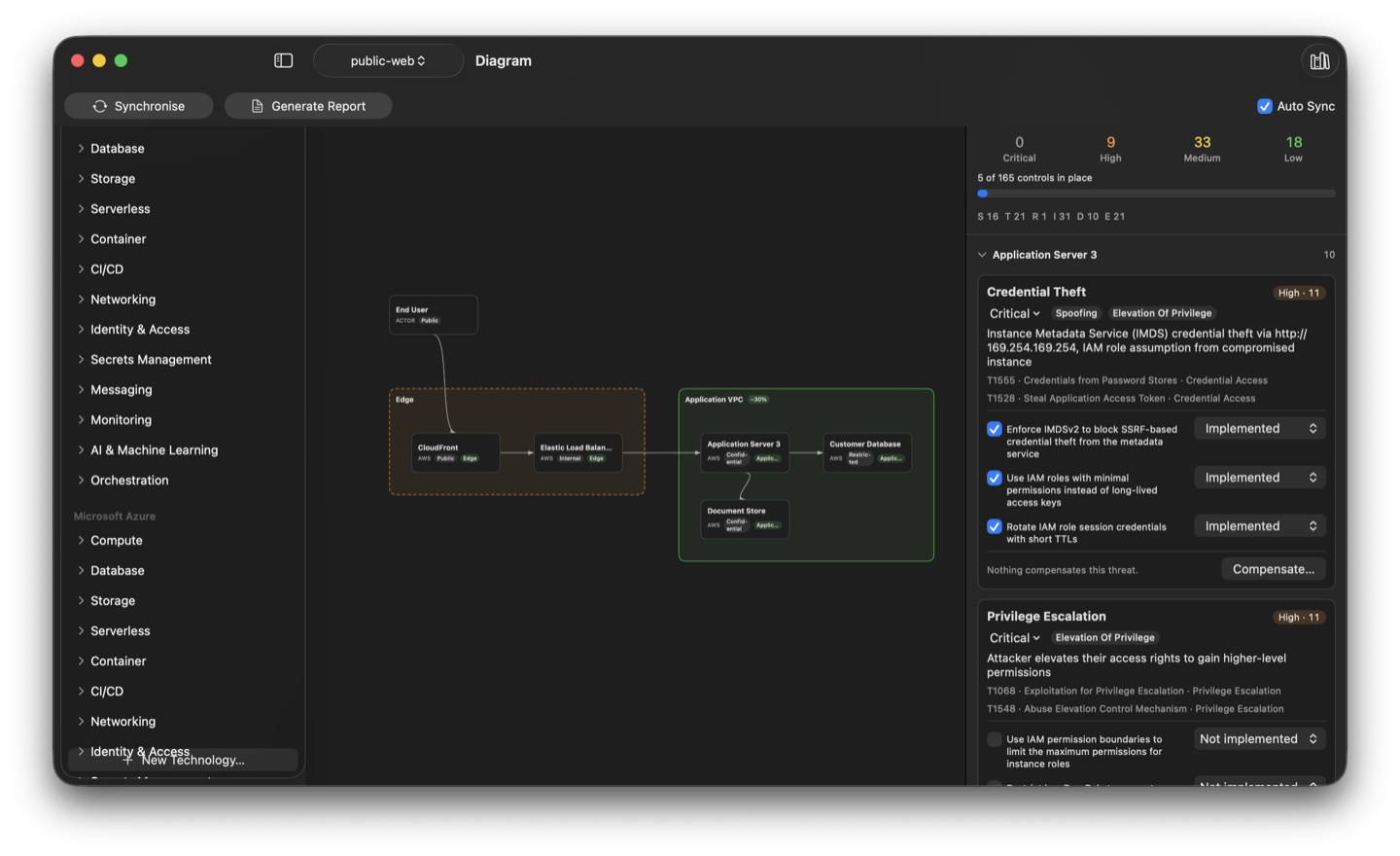
- the macOS canvas The application draws the same files, and Auto Sync writes the files when the model changes and redraws the diagram when a file changes on disk.
- shared element libraries A team writes technologies, threats and controls into a .lib file and shares it. The label prefixes every id it declares, so two teams cannot clash. library.lock.json records the repository, the tag and the sha256 of each file.
- a fixed scoring order Base severity, then a severity override, then the zone reduction, then the pathway mitigation, then one compensating control. Two compensating controls give the stronger of the two, not the sum.
- markdown reports threatmodeller report writes one .md file for each system. A report is an artefact, so a synchronise does not write it.
- your own git, no credential The application runs git as a child process, so a private repository works through the ssh-agent key and the credential helper you already have. This application holds no credential, reads none and prompts for none.
// why text files, not a diagram tool
a diagram tool
- The model lives in a file only that tool opens.
- A reviewer reads an image, and cannot see what changed.
- The diagram and the code drift apart, and nothing measures the distance.
- The answer to a threat lives in a spreadsheet beside it, or in nobody's head.
- The build knows nothing about the model.
Craig's Threat Modeller
- The model is two text files beside the code.
- A reviewer reads the diff, line by line, in the pull request.
- A new component raises its threats the moment the file changes.
- The answer to a threat sits in the .controls file, with a note and a status.
- The build fails while a threat has no answer.
// install
The application:
$ open threatmodeller.dmg
# drag threatmodeller to Applications
The command line executable:
$ tar xzf threatmodeller-cli-macos.tar.gz
$ ln -sf "$PWD/threatmodeller" ~/.local/bin/threatmodeller
$ export PATH="$HOME/.local/bin:$PATH"
In continuous integration:
$ threatmodeller library verify && threatmodeller check
The application installs the same executable: threatmodeller ▸ Install Command Line Tool… writes a link in ~/.local/bin, and asks for no password.
// license: MIT
·
catalogue: Threat Model Library v1.0.1 (CC BY 4.0)
·
source: github.com/craigjbass/threat-modeller
·
version: latest